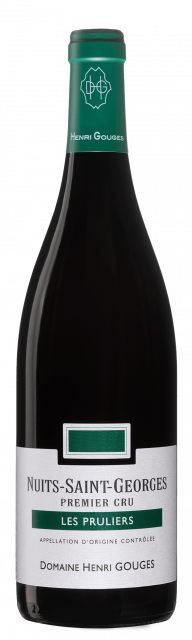
Presentation
An essential reference in Nuits-Saint-Georges, Domaine Henri Gouges is a family estate where six generations have succeeded each other. Specializing in the expression of Pinot Noir, it exploits 14 hectares, spread over 10 parcels classified as AOC, including 7 Premiers Crus and a prestigious monopoly: Clos des Porrets Saint-Georges. The estate is also famous for Pinot Gouges, a white mutation of Pinot Noir discovered in Clos des Porrets in 1936. Following the principles of Organic Agriculture, the vines are cultivated with great respect for the soil and biodiversity. In the cellar, vinifications are low-intervention, with infusion extraction, gentle pressing, and aging in French oak barrels (10 to 30% new wood). The estate's wines combine power and refinement, offering cuvées designed for long aging.
Location
The Les Pruliers parcel is located in the southern part of Nuits-Saint-Georges, mid-slope between 230 and 260 metres in altitude. This renowned Premier Cru lies in a sunnier zone of the appellation, facing due east, which promotes even and complete ripening. The vines are planted on moderate slopes near the forest line. This positioning allows for wines of assertive character, depth and structure, making it one of the emblematic sites of southern Nuits-Saint-Georges. The regularity of this climat makes it a benchmark for power and precision within the appellation.
Terroir
The soil in Les Pruliers consists of red clay mixed with limestone gravel, with good depth to allow for wide and deep rooting. This warm, well-exposed terroir gives the wine density, richness and maturity. The high limestone content, however, brings freshness and tension, balancing the structure. Grapes from this site produce deeply coloured, concentrated juice with firm tannins and notable ageing potential. Les Pruliers offers the best of both worlds: intensity and refinement, power and energy, with a strong identity true to its origins.
In the vineyard
The vineyard is farmed using sustainable practices, with great respect for soil health and biodiversity. No herbicides are used, and the soils are ploughed regularly. Natural grass cover is managed to reduce erosion and encourage microbial life. Treatments are minimal and only applied when necessary, depending on vintage conditions. This precision viticulture ensures optimal ripeness while preserving the terroir’s integrity. The goal is to harvest healthy, concentrated grapes that express their origin and support meticulous winemaking.
Harvest
Harvesting is done entirely by hand, with careful sorting in the vineyard to retain only the healthiest bunches. Grapes are transported in small crates to preserve their integrity. Depending on the year, the fruit is partially or fully destemmed before being gravity-fed into vats. This gentle process minimises handling and supports a natural fermentation. Winemaking is carefully monitored, with tailored pump-overs and punch-downs to ensure balanced extraction and purity of fruit, suited to the vintage and the personality of the site.
Winemaking
Fermentation takes place in open vats with indigenous yeasts, followed by maceration lasting 15 to 18 days.
Ageing
The wine is then aged for around 18 months in oak barrels, with 25 to 30% new wood. This ageing process refines the tannins, deepens the structure and brings harmony without overwhelming the fruit. Bottling is done without fining or systematic filtration to preserve texture, precision and complexity. The result is a wine that reflects the full character and nobility of the Les Pruliers climat.
Varietal
Pinot Noir : 100%
Specifications
Age of vines : 60 years old

Serving
Serve between 16°-18°C
Ageing potential
Over 15 years
Tasting
Nuits-Saint-Georges Premier Cru Les Pruliers shows a deep garnet hue. The nose is expressive and layered, with aromas of ripe black fruits, morello cherry, violet, leather and forest floor. On the palate, it is full-bodied and structured, with firm but well-balanced tannins and a vibrant mineral freshness. The finish is long and focused, with purity and tension. This is a cellar-worthy wine that will evolve beautifully over time, developing greater complexity and a silky texture, but it can also be enjoyed young after proper decanting.
Food pairings
This wine pairs beautifully with generous, flavourful dishes such as herb-crusted leg of lamb, roasted beef tenderloin or porcini mushroom risotto. It also works well with vegetarian recipes rich in umami, like a mushroom and lentil pie. For cheese, it pairs nicely with an aged Langres. On the sweet side, it complements fig tart or black cherry clafoutis. Its controlled power, complexity and mineral backbone make it a natural companion for bold dishes or more delicate, elegant combinations.