Terroir
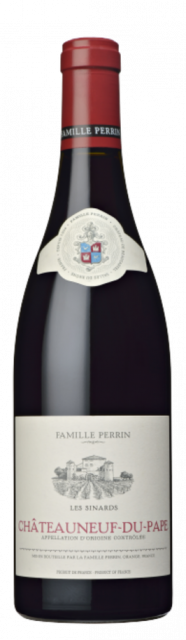
Originating from three complementary origins at the heart of the Châteauneuf-du-Pape appellation, Les Sinards blends the young vines of Beaucastel (less than 20 years old), the Clos de Châteauneuf facing southwest, and a vineyard located in the Grès sector, just a few kilometers from the historic estate. The geological base is typical of the southern Rhône Valley: Miocene marine molasse covered with rolled pebbles from the Alpine diluvium, along with a plot planted on Urgonian limestone. These poor and draining soils force the vine to dive deep, promoting the natural balance of the berries. The rolled pebbles store the heat of the day to release it at night, ensuring a uniform ripening of the Grenache, the predominant grape in the blend. The Clos contributes southwest-facing Syrah vines, providing tension, spices, and structure, while the young vines of Beaucastel offer a more immediate fruit and a more accessible expression in their youth. This diverse terroir shapes a Châteauneuf-du-Pape red wine that is both sunny and precise, where Rhône generosity is balanced by natural freshness and an elegant framework.
Winemaking
The quest for precision begins in the vineyard, with maturity checks and berry tastings carried out as early as August to determine the optimal harvest date. Each grape variety – Grenache, Mourvèdre, and Syrah – is harvested separately to preserve its identity. Upon arrival at the winery, the grapes undergo rigorous sorting. Some of the Syrah is vinified as whole clusters to bring tension, freshness, and aromatic complexity. The remaining Syrah, as well as the Grenache and Mourvèdre, are destemmed before fermentation. Vinification takes place in wooden and stainless steel vats, following the historical expertise of the house, with precise temperature control and tailored extractions for each grape variety. The goal: to preserve the fruit's brightness while building a delicate and balanced structure.
Ageing
After the fermentations, the batches are tasted individually to define the final blend. The wine is then aged in large oak vats for two years, a choice that emphasizes harmony and the integration of tannins without marking the wine with wood. This long aging process refines the material, gains depth, and prepares the wine for a beautiful evolution in the cellar.
Varietals
Grenache noir
Syrah
Specifications
Alcohol content : 14.5 % vol.

Serving
Serve this red Châteauneuf-du-Pape Les Sinards at 16-17°C to preserve the balance between the generosity of the fruit and the natural freshness of the vintage. In its youth, decanting for about an hour is recommended to soften the tannins and release all the aromatic complexity of the predominant Grenache. Opt for a wide Rhône-type glass to allow the wine to fully open up and express its spicy depth and velvety texture. Cellar tip: if the bottle has a few years, opening it 30 minutes before serving will suffice — no need to decant too much to preserve the finesse of the evolution.
Tasting
The Sinards opens with a clear and expressive fruit profile: black cherry, ripe raspberry, fresh plum, enhanced by a hint of fine pepper and typical dried herbs from the garrigue. The long aging in large oak barrels underlines the whole without dominating, letting the purity of Grenache shine through. On the palate, the attack is soft, almost caressing, then the wine gains in amplitude. The texture is generous but never heavy. The tannins are present, structuring, while remaining fine and well-integrated. This wine bears the signature of Châteauneuf-du-Pape: controlled warmth, solar depth, balanced by a freshness that extends the finish. This Châteauneuf-du-Pape combines power and accessibility. It has the expected richness of a great wine from the southern Rhône, but with immediate readability, energy, and elegance that make it appealing from today.
Food pairings
It pairs perfectly with a duck parmentier, where the richness of the meat meets the depth of the Grenache. On a shoulder of lamb confit with herbs, it reveals all its Mediterranean dimension, highlighting notes of scrubland and sweet spices. For a more contemporary approach, it works remarkably well with a slightly smoked pulled pork, whose silky texture complements its ripe tannins. A lamb tagine with prunes and almonds will enhance its generosity and aromatic complexity. For cheese, opt for a roasted Mont d'Or or a matured pressed cheese: the wine's structure balances the fat, while its freshness lengthens the finish. A red Châteauneuf-du-Pape that excels with a warm, sharing cuisine, but always demanding in the quality of the products.