Presentation
Nestled at the foot of the prestigious Dentelles de Montmirail in Sablet, the vines of Domaine La Perdrière thrive on 27 hectares of organically farmed land. The estate was taken over in 2010 by Vasco Perdigao, supported by his wife Sonia, a former nurse who retrained as a winemaker.
Vasco honed his craft with passion over several years in the renowned vineyards of the Northern Rhône. Yet it was in the southern part of the Rhône Valley that he chose to settle and fully express his vision as a vigneron.
The year 2024 marks a turning point for the estate: the winery has been expanded and modernized to improve working conditions and optimize the quality of the wines throughout their vinification, ageing, and storage phases. A new visual identity — including redesigned labels — affirms this transformation.
The name Domaine Chamfort is now a thing of the past, making way for Domaine La Perdrière. This new name is a tribute to the Perdigao family name — meaning “partridge” in both Provençal and Portuguese. La Perdrière is thus the place where partridges find shelter — and symbolically, a home for our wines as well.
Location
The vineyard was acquired in 2014 and lies on Mont Bayon at an altitude of 450 meters. The vines, around sixty years old, are deeply rooted and draw remarkable strength from the soils, composed of large, ancient limestone scree, quartz veins, and a base of red clay. This contrasting terroir — both sun-drenched and cool — delivers balance and minerality, where each of our interventions is a challenge to nature itself.
Terroir
High-altitude vineyard on limestone scree with quartz veins and red clay. The terroir brings a natural tension between richness and freshness, enhancing the wine’s complexity.
In the vineyard
The entire estate has been certified organic since the 2021 harvest. Traditional soil management includes winter hilling of the vines and spring ploughing. Compost is applied every three years, alternating with organic amendments.
Harvest
Manual harvest.
Winemaking
In the cellar, Vasco conducts long macerations to gently extract the full character of the grapes.
Ageing
Aged for 18 months in French oak demi-muids and amphorae.
Varietal
Grenache : 100%
Specifications
Age of vines : 60 years old

Serving
Recommended serving temperature: Around 16–17 °C, allowing the wine to fully express its aromatic complexity.
Ageing potential
5 to 10 years
Tasting
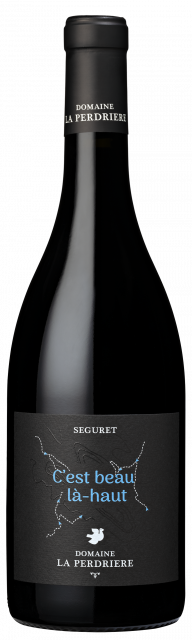
C’est beau La-Haut shows a deep purple robe with dark garnet reflections. The nose offers a rich bouquet: ripe black fruits (blackcurrant, blackberry), black plum, intertwined with soft spices (black pepper, clove) and delicate toasty notes (vanilla, mocha). Subtle hints of undergrowth and dried garrigue herbs bring freshness and finesse. On the palate, the wine opens with generous, fleshy volume. The tannins are firm but well-integrated, lending a broad, velvety texture. The mid-palate is marked by fine tension — a balance between fruit density and freshness — and the finish lingers elegantly on spices, licorice, black fruit, and a discreet
Visual appearance
Deep purple with garnet hues.
At nose
Ripe black fruits, garrigue herbs, spice, vanilla and mocha.
On the palate
Generous, structured, velvety tannins, long and fresh finish with spice and minerality.
Food pairings
With its firm structure, concentrated fruit and assertive tannins, C’est beau La-Haut pairs perfectly with rich and flavorful dishes that can match its intensity. Recommended pairings include:
Grilled or roasted red meats: peppered hanger steak, herb-crusted rack of lamb, or ribeye with wild mushroom sauce.
Game: hare, venison or pheasant stews or slow-cooked in rich sauces will highlight the wine’s depth.
Hearty stews and sauced dishes: Provençal beef daube, spiced tomato-based dishes, or “gardiane de taureau” — pairing the fat of the dish with the wine’s boldness.
Bold cheeses: Blue cheese, aged Cantal, or well-matured Ossau-Iraty — cheeses with enough character to stand up to the wine’s structure.
Flavored Mediterranean cuisine: dishes with lamb, daube, moussaka, or slow-roasted eggplant with olive oil and herbs to highlight the wine’s herbal and spicy notes.