Presentation
Located in Saint-Aubin, the family's birthplace, Domaine Larue spans 17 hectares and covers four prestigious villages: Saint-Aubin, Chassagne-Montrachet, Puligny-Montrachet, and Aloxe-Corton. Managed by Denis and Didier Larue, accompanied by their sons Bruno and Vivien, this family estate combines tradition and modernity. The new generations bring a renewed vision of viticultural practices while remaining faithful to the values passed down for several decades. The meticulous work in the vineyards, combining reasoned cultivation and respect for the terroir, allows for the production of wines of great finesse and pure expression. Vinification is precise and low-intervention, with carefully controlled barrel aging. The estate's wines stand out for their balance, aromatic intensity, and aging potential, perfectly illustrating the nobility of the Côte de Beaune terroirs. The harmonious association between ancestral know-how and innovation ensures the wines of the estate a unique signature, marked by elegance and aromatic depth.
Location
The south/southwest-facing plots, situated at an altitude of 350 meters, lie mid-slope on limestone soil. These Pinot Noir vines were planted between 1973 and 1980 at a density of 10,000 vines per hectare, covering a surface area of 1.08 hectares. The Eduens lived in the region in the 1st century BC; their capital was Bibracte.
Terroir
Limestone soil.
In the vineyard
Trained using the Cordon de Royat method, the vines are carefully debudded in spring and rigorously managed throughout the season. The soil is either mechanically worked (hilling, de-hilling, light tilling) or grass-covered depending on vine vigor. During summer, disease control is carried out using a reasoned approach. In July, manual leaf thinning is performed, and lateral shoots (“gourmands”) are removed. This allows the grape clusters to benefit from sunlight, improving aeration and grape health.
Harvest
Following precise ripeness monitoring, the grapes are hand-harvested and transported to the winery in small perforated crates. The harvest is sorted on a vibrating table to remove insects and dry berries. Grapes then pass along a conveyor belt where four to six people remove any clusters that could compromise quality. The entire harvest is destemmed, and the berries are gently conveyed into vats.
Winemaking
After a cold maceration of three to five days, alcoholic fermentation begins. During the active phase, the must is punched down three times a day. As fermentation slows, the wine enters a refinement phase, with daily tastings. After 15 to 20 days, the pomace is pressed. The free-run juice is settled and transferred by gravity into barrels. The entire cuvée is aged in barrels that have previously held one vintage.
Ageing
After 12 months of aging on fine lees, the wine is blended in a temperature-controlled stainless steel tank for an additional 6 months of maturation. A light fining precedes bottling.
Varietal
Pinot Noir : 100%
Specifications
Alcohol content : 12.5 % vol.
Age of vines : 45 years old

Serving
Serving temperature: 13–15 °C
Ageing potential
3 to 5 years
Tasting
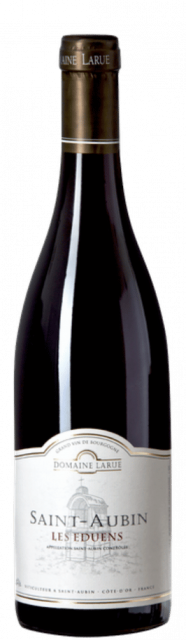
Saint-Aubin Les Eduens displays a clear ruby color. On the nose, the Pinot Noir varietal reveals itself with vibrant red fruit aromas that awaken the palate. On the palate, the wine is fresh and supple, with soft tannins—an immediately pleasurable wine.
Visual appearance
Clear ruby hue.
At nose
Red fruit aromas, expressive and varietal-driven.
On the palate
Fresh and supple with soft, refreshing tannins.
Food pairings
Saint-Aubin Premier Cru Les Eduens is an elegant and structured red wine made from Pinot Noir. Recommended pairings:
Red meats: Roasted beef tenderloin or herb-crusted leg of lamb pair beautifully with the wine’s tannins and red fruit aromas.
Game: Wild duck or venison with rich sauces complement its depth and structure.
Slow-cooked dishes: Beef bourguignon or coq au vin are excellent choices to match the wine’s richness and complexity.
Aged cheeses: Comté or Reblochon also make fine companions for this wine.