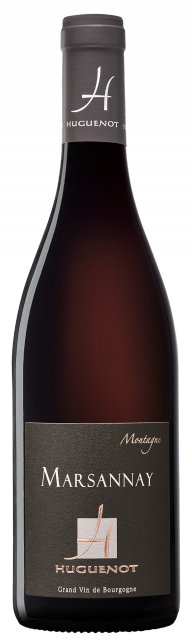
Presentation
Located in the commune of Marsannay-La-Côte, in the Côte de Nuits, 5km south of Dijon, the domaine has grown over the generations. Vines have been handed down in this family since 1800, thanks to their ancestors. Today, Valérie and Philippe manage and develop the estate, cultivating 23 hectares of vines in the Marsannay, Fixin and Gevrey-Chambertin appellations. For over 40 years, the domaine has been a member of the Vignerons Indépendants de France confederation.
Location
Located at the very top of the vineyard slope in Marsannay-la-Côte, the "Montagne" climat covers a wide topographic range, from 292 to 354 meters in altitude.
En La Montagne clearly refers to its elevated geographic position.
This climat lies on a fully limestone-based soil structure, consisting of Prémeaux limestone, white oolite, and above all, Comblanchien limestone.
Terroir
Soil composed of Prémeaux limestone, white oolite, and predominantly Comblanchien limestone.
In the vineyard
Soil and vine work are essential: moderate plowing at the end of winter aerates the soil and stimulates microbial life. Compost adapted to each plot is applied to naturally restart the plant’s vegetative cycle.
All vineyard tasks—debudding, trellising, leaf-thinning—are performed with precision throughout the season in pursuit of optimal quality.
These meticulous practices help control yields and lead to more concentrated grapes.
Harvest
Harvesting is done at the optimal point of grape maturity.
Winemaking
The grapes are picked entirely by hand, first sorted in the vineyard, then again in the winery by a team of 8 people working across two sorting tables. Grapes arrive in 15-kg perforated crates to best preserve the fruit.
The first sorting table removes moisture, dried berries, and small insects (ladybugs, earwigs, etc.). The second allows the team to select only the finest bunches, and possibly retain whole clusters depending on the vintage.
Depending on the year and cuvée, 20% to 50% of the harvest is fermented whole. Sorting is a key step in producing great wines.
The selected grapes are transferred into temperature-controlled vats via stainless steel bins for a cold maceration, ideal for Pinot Noir, lasting 7 to 10 days.
Fermentation is traditional and natural, relying solely on the grape’s indigenous yeasts.
Alcoholic fermentation occurs spontaneously, and the wine is allowed to infuse for 10 to 15 days, with 1 to 2 tastings per day.
Based on our impressions, gentle punch-downs and pump-overs are performed to ensure a delicate yet precise extraction.
Each wine finds its own balance, and temperatures are carefully monitored during fermentation.
The marc is then gently pressed in our pneumatic press, and the wine is racked by gravity for maximum respect.
Ageing
The wine is aged for 12 to 18 months, depending on the vintage, in oak barrels from the finest French forests (Central France).
New oak makes up 10% to 30% of the barrels, depending on the appellation. Red wines are aged in traditional 228-liter Burgundy barrels from various coopers and forests, with medium to deep toasting to bring out the wood’s core.
Varietal
Pinot Noir : 100%
Specifications
Production volume : 9 000
Age of vines : 40 years old

Serving
Serving temperature: 16 to 18°C
Ageing potential
3 to 5 years
Tasting
Black cherry notes gradually emerge with aeration. The palate is well-rounded and supple.
This is a smooth, expressive, full-bodied wine, without rough edges.
This Marsannay reveals a generous profile, with rich, ripe substance.
Food pairings
Marsannay reds naturally pair with red meats: bone marrow ribeye, hanger steak with shallots, or ostrich steak.
They also complement freshwater fish (pike, zander, even stuffed carp), chop suey, sautéed vegetables, fine charcuterie, game birds, and cow’s milk cheeses.
An older vintage will beautifully accompany Époisses, Munster, or any mature cheese.